Introduction
In the last two decades, esports has transformed from a niche subculture into a global phenomenon that rivals traditional sports in scale, excitement, and profitability. What was once dismissed as “kids playing video games” has evolved into a multi-billion-dollar industry with professional teams, celebrity players, sold-out arenas, and millions of fans watching worldwide. The evolution of esports represents more than just the growth of gaming; it is the story of how digital entertainment, technology, and global connectivity have reshaped modern competition.
This blog explores the rise of esports, tracing its roots, growth, cultural impact, and future potential. From the days of arcade tournaments to the massive global events streamed to millions, esports has become one of the most exciting movements in entertainment history.
The Origins of Competitive Gaming
The concept of competitive gaming is not new. In fact, its origins go back to the early 1970s when video games first entered popular culture. One of the earliest recorded gaming competitions was held in 1972 at Stanford University, where students competed in a game called “Spacewar.” The winner received a year’s subscription to Rolling Stone magazine, a modest prize by today’s standards, but a symbolic moment marking the beginning of organized digital competition.
The 1980s saw the birth of arcade gaming, and with it, the rise of high-score competitions. Players battled to get their initials on leaderboards in games like “Pac-Man” and “Donkey Kong.” Magazines such as Twin Galaxies began documenting record scores, turning the best players into local legends. While the idea of esports was far from reality, the spirit of competition was clearly present.
In the 1990s, the introduction of personal computers and early internet connections changed everything. Games like “Doom,” “Quake,” and “StarCraft” became popular for multiplayer competition, and local area network (LAN) parties became the hubs for gaming tournaments. This period laid the foundation for organized esports as we know it today.
The Growth of Esports in the 2000s
The early 2000s marked the transition from local competitions to global tournaments. Faster internet, advanced hardware, and new gaming genres fueled this change. Games like “Counter-Strike,” “Warcraft III,” and “StarCraft: Brood War” became global phenomena. South Korea, in particular, became the epicenter of esports culture. Professional teams formed, sponsorships emerged, and televised matches drew millions of viewers. The Korean government even recognized esports as a legitimate career path, and the country produced some of the first esports superstars.
During this period, online gaming platforms such as Battle.net and Xbox Live enabled players from around the world to compete against each other. The concept of professional gaming gained traction as organizations began to offer structured leagues, contracts, and prize money. Events like the World Cyber Games and Major League Gaming (MLG) were pivotal in legitimizing esports on the international stage.
The 2000s also saw the birth of streaming technology, although it was still in its infancy. Platforms like YouTube and early live-streaming services allowed gamers to share their gameplay, creating a bridge between players and fans. This connection would later become a cornerstone of esports’ massive global audience.
The Explosion of Esports in the 2010s
If the 2000s built the foundation, the 2010s were the era when esports exploded into the mainstream. Several key developments contributed to this unprecedented rise.
First, streaming platforms such as Twitch and YouTube Gaming revolutionized how audiences consumed gaming content. Fans could now watch live matches, follow their favorite players, and engage with communities in real time. The accessibility and interactivity of streaming created a cultural shift, making esports both participatory and social.
Second, game developers began designing titles specifically with esports in mind. Games like “League of Legends,” “Dota 2,” “Counter-Strike: Global Offensive,” and “Overwatch” were built for competitive play. Developers organized leagues, structured tournaments, and maintained balanced gameplay to ensure fair competition.
Third, major corporations and investors began to see esports as a lucrative industry. Sponsorship deals, media rights, and merchandise sales brought in millions of dollars. Traditional sports organizations also entered the scene, with football clubs and NBA franchises forming their own esports teams.
The result was a professional ecosystem that rivaled traditional sports in structure and scale. Esports organizations operated with coaches, analysts, nutritionists, and brand managers. Players signed contracts, trained for hours each day, and competed in global tournaments with prize pools reaching tens of millions of dollars.
The Spectacle of Global Tournaments
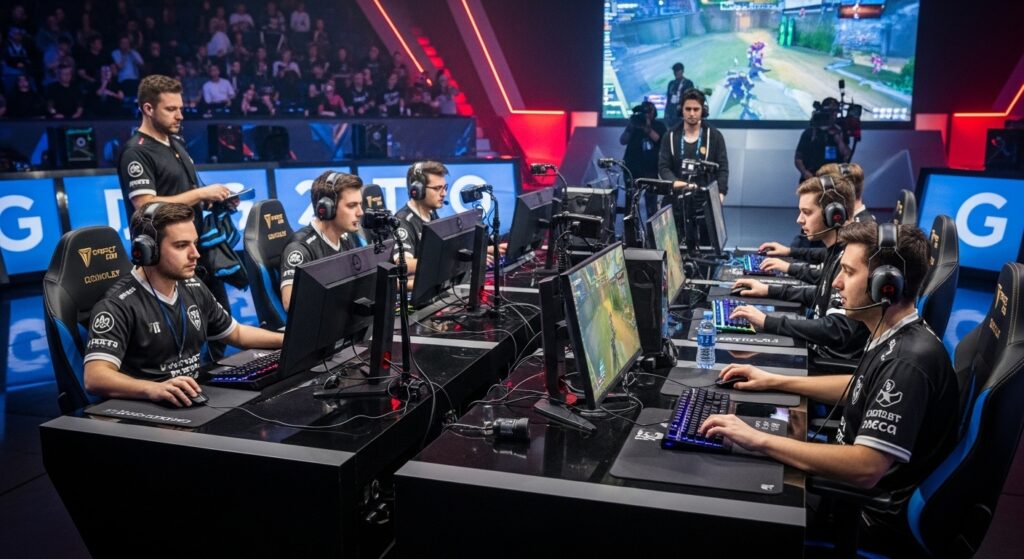
Today, esports tournaments are massive spectacles that attract millions of live viewers and fill arenas around the world. Events like “The International” for Dota 2, “League of Legends World Championship,” and “Fortnite World Cup” have become global celebrations of digital competition.
The scale of these tournaments is staggering. The International 2021, for instance, offered a prize pool exceeding forty million dollars, funded largely through community crowdfunding. The League of Legends World Championship draws tens of millions of live viewers each year, surpassing the audience of many traditional sporting events.
These tournaments are not just about competition; they are full-scale entertainment experiences. Fans witness elaborate opening ceremonies, musical performances, and cinematic storytelling that make esports events rival the grandeur of the Olympic Games or the Super Bowl. The production quality, visual effects, and fan engagement strategies continue to evolve, blending gaming, culture, and technology into an immersive spectacle.
The Role of Technology in Esports Evolution
Technology has been at the heart of esports’ success. Advances in graphics, computing power, and internet connectivity have made competitive gaming more accessible and enjoyable for both players and audiences. High-speed broadband connections and cloud gaming have reduced latency, ensuring fairer competition and smoother gameplay experiences.
Streaming platforms have enabled anyone with a stable internet connection to watch professional matches from anywhere in the world. Social media integration allows fans to interact with players and commentators in real time, creating a community-driven experience unlike any other sport.
Moreover, innovations in artificial intelligence, augmented reality, and virtual reality are shaping the future of esports. AI-driven analytics help teams study opponents and refine strategies, while AR and VR promise to create even more immersive spectator experiences. The integration of these technologies is pushing the boundaries of what competitive gaming can offer.
The Professionalization of Esports
In the early days, esports players were often amateurs playing for passion rather than profit. Today, esports has become a full-fledged profession. Top players sign contracts worth hundreds of thousands of dollars, with additional income from sponsorships, streaming, and brand partnerships.
Organizations have adopted structures similar to traditional sports teams, complete with coaches, analysts, psychologists, and fitness trainers. The goal is to optimize player performance and maintain mental and physical health in a high-pressure environment.
Training regimens are intense, often involving eight to twelve hours of practice per day. Teams study gameplay footage, develop strategies, and scrimmage against opponents. The competitive nature of esports demands discipline, teamwork, and adaptability—qualities that are no different from those required in physical sports.
The professionalization of esports has also extended to education. Universities around the world now offer esports scholarships, degrees in game design and management, and dedicated facilities for training. This institutional support further legitimizes esports as a serious career path and academic field.
The Economic Power of Esports
The esports industry has grown into a multi-billion-dollar economic powerhouse. Revenues come from multiple streams, including sponsorships, advertising, merchandise, ticket sales, media rights, and digital content. Major brands from technology, energy drinks, fashion, and automotive sectors have invested heavily in esports, seeking to tap into the young, digitally engaged audience.
In addition to direct revenue, esports stimulates growth in related industries such as hardware manufacturing, streaming services, event management, and digital marketing. Cities around the world have begun to host major esports events, recognizing their potential for tourism and economic impact.
The economic ecosystem also includes the rise of content creators and influencers who thrive within the gaming community. Streamers and professional players have become celebrities, attracting millions of followers and building personal brands that extend beyond gaming.
The Cultural Impact of Esports
Esports has significantly influenced modern culture, particularly among younger generations. It has reshaped entertainment consumption, blurring the lines between sports, gaming, and media. Fans not only watch competitions but also actively engage with players, content creators, and online communities.
Gaming culture has transcended stereotypes of isolation and antisocial behavior. Today, it is seen as a global form of connection and collaboration. Esports promotes teamwork, strategic thinking, and problem-solving skills. It also fosters inclusivity by connecting people across cultures, languages, and backgrounds through a shared passion for gaming.
Moreover, esports has influenced music, fashion, and art. Collaborations between game developers, musicians, and designers have created crossover events that appeal to both gamers and mainstream audiences. Virtual concerts, in-game events, and branded merchandise have become major cultural touchpoints, reinforcing the growing influence of digital entertainment.
The Challenges Facing Esports
Despite its immense success, esports faces several challenges that could shape its future trajectory.
One major concern is player burnout. The intense training schedules, constant travel, and pressure to perform can take a toll on mental and physical health. Unlike traditional sports, the career lifespan of a professional gamer is often short, sometimes ending before the age of thirty due to fatigue or declining reflexes.
Another challenge is the issue of regulation. Esports operates globally, but lacks a unified governing body. This leads to inconsistent rules, contract disputes, and potential exploitation of players. Efforts are underway to create more structured governance and fair labor practices, but the industry is still developing in this area.
Cheating and match-fixing also pose threats to the integrity of esports. As the stakes grow higher, so does the incentive for unethical behavior. Advanced anti-cheat technologies and stricter penalties are being implemented to combat these issues, but maintaining competitive fairness remains a constant battle.
Additionally, inclusivity and diversity continue to be areas for improvement. While esports is accessible in theory, there are still barriers for women and marginalized groups in terms of representation, safety, and equal opportunity. The community is becoming increasingly aware of these issues, and progress is being made, but there is more work to be done.
Esports and Traditional Sports: Rivals or Allies?
A fascinating aspect of esports’ growth is its relationship with traditional sports. Some view them as competitors for audience attention, while others see potential for collaboration.
Traditional sports organizations have increasingly entered the esports arena. Football clubs like Paris Saint-Germain, Manchester City, and FC Barcelona have launched esports divisions. The NBA created the NBA 2K League, and Formula 1 has established its virtual racing series. These partnerships bring credibility to esports while helping traditional sports connect with younger, tech-savvy audiences.
At the same time, esports has borrowed heavily from traditional sports structures—team franchises, leagues, player contracts, and even sports analytics. The two worlds are converging in ways that highlight the universal appeal of competition, skill, and storytelling. Rather than rivals, esports and traditional sports are becoming complementary forms of entertainment that reflect different aspects of the modern digital era.
The Future of Esports
The future of esports looks incredibly bright. As technology continues to advance, new forms of competition and fan engagement will emerge. The rise of mobile gaming, for instance, is expanding esports’ reach into regions with limited access to high-end PCs or consoles. Games like “Mobile Legends,” “PUBG Mobile,” and “Free Fire” have already built enormous esports communities, particularly in Asia and Latin America.
Virtual reality and augmented reality could redefine the spectator experience, allowing fans to immerse themselves in virtual arenas or experience matches from the players’ perspectives. Artificial intelligence will further enhance player training, strategy analysis, and broadcast production.
Esports is also poised to become a permanent part of global sporting culture. Discussions about including esports in major international sporting events, such as the Olympics, continue to gain traction. Whether or not that happens soon, esports has already achieved something remarkable—it has become a legitimate and respected form of competition recognized worldwide.
Conclusion
Esports is not just about gaming; it is a symbol of the digital age’s creativity, connectivity, and innovation. From humble beginnings in university basements and arcades to sold-out stadiums and global tournaments, esports embodies the evolution of entertainment in the 21st century.
It unites technology, passion, and human skill in a way that transcends geographical and cultural boundaries. Esports has given rise to new careers, industries, and communities, shaping how the world views competition and collaboration.
As it continues to evolve, esports will remain at the forefront of digital transformation. It is not merely the future of gaming—it is the future of sports, entertainment, and global culture itself.



More Stories
Pixels to Podiums: The Evolution of Esports in the Modern Era
Pixels to Powerhouses: How Esports Redefined Competition in the Digital Age
Pixels to Powerhouses: How Esports Redefined Competition in the Digital Age